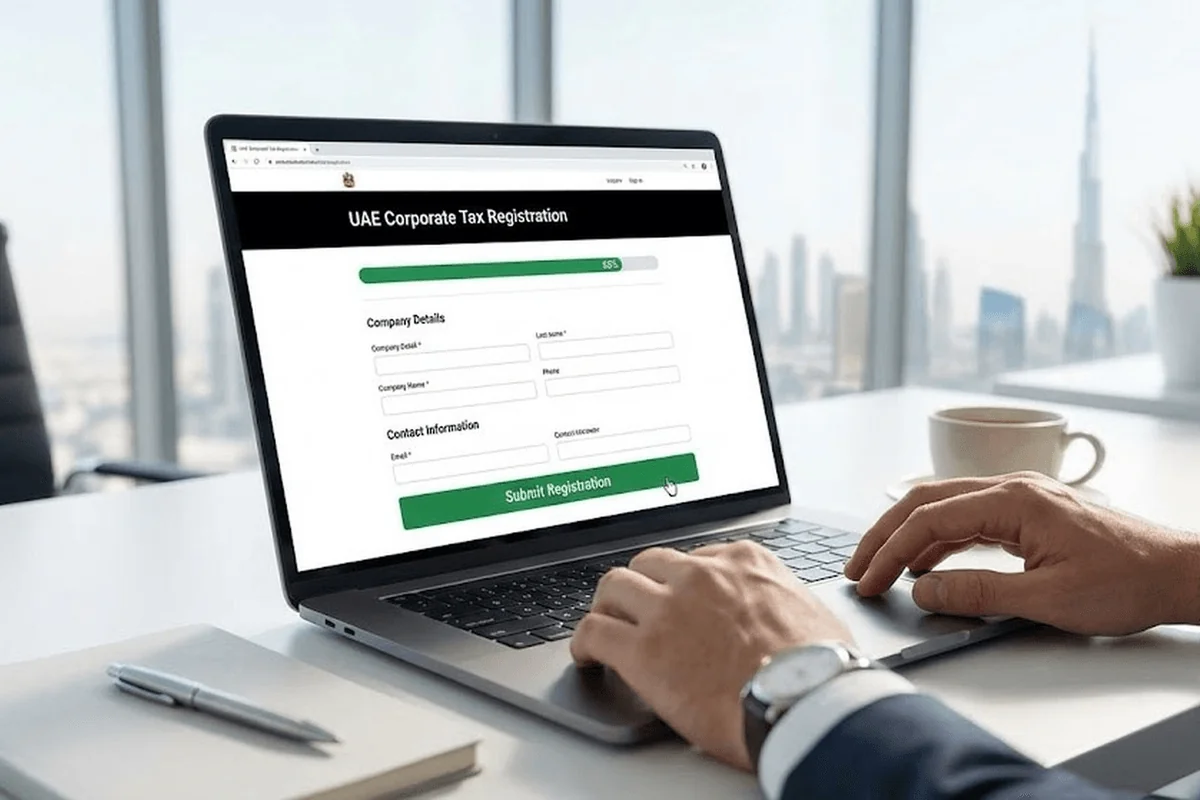
How to Register for Corporate Tax in UAE
How to Register for Corporate Tax in UAE (Step-by-Step)
Corporate Tax registration is not optional in the UAE. Every business, regardless of size, profitability, or location, must register with the Federal Tax Authority (FTA).
And the penalties for missing the deadline are immediate and expensive. We’ve seen it happen too many times: founders launch their company, focus on building the business, and suddenly discover they owe AED 10,000 for late registration.
This guide walks you through exactly when you need to register, how to do it, what documents you need, and how to avoid costly mistakes.
Why Registration Matters (Even If You Owe Zero Tax)
Here’s what many business owners misunderstand: Corporate Tax registration is mandatory for all businesses, even if you never owe a single dirham in tax.
Registration is separate from payment. Even if your annual profit is below AED 375,000 and your tax liability is zero, even if you’re a Free Zone company qualifying for the 0% rate, even if you’re exempt from Corporate Tax entirely, you still must register and file annual returns.
The FTA uses registration to track all businesses operating in the UAE. It’s how they monitor compliance, verify eligibility for exemptions or reliefs, and ensure the tax system functions properly.
Skipping registration because “I don’t think I’ll owe tax” is not a valid excuse. The system doesn’t care about your intentions. It enforces deadlines automatically.
When You Must Register: Critical Deadlines
Registration deadlines depend on when your business was established.
New Businesses (Established After June 1, 2023)
If your company was registered after June 1, 2023, you must register for Corporate Tax within 3 months (90 days) of your company registration date.
This deadline is strict. There are no extensions, no grace periods, and no warnings. Once the 90-day window closes, the FTA’s system automatically issues a penalty of AED 10,000.
Let’s say you registered your company on March 15, 2025. Your Corporate Tax registration deadline is June 13, 2025. If you register on June 14, you’re late, and the AED 10,000 penalty applies immediately.
This is the single most common Corporate Tax penalty we see. Founders register their company, get straight into operations, and the 90-day deadline passes before they realize what happened.
Existing Businesses (Established Before June 1, 2023)
Businesses established before June 1, 2023 had different registration windows based on their financial year structure. Most of these deadlines have already passed.
If you established your business before June 1, 2023 and haven’t registered yet, check your status on the EmaraTax portal immediately. You may already be subject to penalties.
Voluntary Registration
Even if you’re not legally required to register yet, such as an individual whose business revenue is below AED 1 million, you can register voluntarily.
Voluntary registration might make sense if you want to start building a compliance history early, you’re planning to apply for specific tax reliefs or exemptions, or you expect your revenue to exceed the threshold soon and want to be proactive.
Who Needs to Register?
Registration applies to all taxable persons under the Corporate Tax law.
Businesses That Must Register
All UAE companies and legal entities, including LLCs, PJSCs, and other corporate structures. Free Zone companies, regardless of whether they qualify for the 0% rate. Foreign companies with a permanent establishment in the UAE. Individuals conducting business activities in the UAE with annual revenue exceeding AED 1 million.
Exempt Entities That Still Must Register
Even if your entity is exempt from paying Corporate Tax, you must register and file annual declarations to maintain your exempt status.
This includes government entities performing exempt functions, qualifying public benefit entities and charities, qualifying investment funds, and pension or social security funds.
Exemption from tax does not mean exemption from compliance.
What You Need Before You Register
Before starting the registration process, gather the following documents and information. Having everything ready will make the process faster and reduce errors.
Required Documents
Trade license (valid and current). Memorandum of Association and Articles of Association. Passport copies of all shareholders and managers. Emirates ID copies of UAE-resident shareholders and managers. Proof of address for the business (tenancy contract, Ejari certificate, or Free Zone license). Bank account details for the business. Contact information including email address and phone number.
Required Information
Company registration date and license number. Business activity description and industry classification. Financial year start and end dates (this determines your filing deadlines). Details of all shareholders, including ownership percentages. Details of all managers and authorized signatories. Expected annual revenue range.
If you’re a Free Zone company, you’ll also need your Free Zone license details and information about whether you intend to apply for Qualifying Free Zone Person status.
Step-by-Step Registration Process
Corporate Tax registration is completed online through the EmaraTax portal. Here’s how to do it.
Step 1: Access the EmaraTax Portal
Go to the official FTA website at eservices.tax.gov.ae. If you don’t already have an account, you’ll need to create one using your UAE Pass or by registering with your email and creating login credentials.
UAE Pass is the government’s digital identity system. If you have it set up, it’s the fastest way to access the portal.
Step 2: Select Corporate Tax Registration
Once logged in, navigate to the “Register for Corporate Tax” section. The portal will guide you through a series of screens asking for information about your business.
Step 3: Provide Business Details
You’ll be asked to enter basic information about your business, including legal name exactly as it appears on your trade license, trade license number and issuing authority, business activity and industry sector, company registration date, and registered business address.
Make sure all information matches your official documents exactly. Any discrepancies can cause delays or rejection of your registration.
Step 4: Enter Financial Information
Specify your financial year start and end dates. This is critical because it determines when your Corporate Tax returns are due.
Most businesses use a calendar year (January 1 to December 31), but you can choose any 12-month period that aligns with your business cycle.
Step 5: Provide Shareholder and Manager Information
Enter details for all shareholders and managers, including full legal names as they appear on passports or Emirates IDs, passport or Emirates ID numbers, nationality, ownership percentage (for shareholders), and contact information.
For foreign shareholders, you may need to provide additional documentation like passport copies or proof of tax residency in their home country.
Step 6: Upload Supporting Documents
Upload clear, legible copies of all required documents in PDF format. The portal will specify which documents are mandatory for your business type.
Common uploads include trade license, memorandum and articles of association, passport or Emirates ID copies, and proof of address.
Step 7: Review and Submit
Before submitting, carefully review all information for accuracy. Incorrect details can delay your registration or require amendments later, which adds time and complexity.
Once you’re confident everything is correct, submit your registration application.
Step 8: Receive Your Tax Registration Number (TRN)
If your application is complete and accurate, the FTA will issue your Tax Registration Number (TRN) within a few business days.
Your TRN is your unique identifier for all Corporate Tax matters. You’ll need it when filing returns, making payments, and communicating with the FTA.
Save your TRN and registration certificate in a secure location. You’ll use them frequently.
What Happens After Registration?
Once you receive your TRN, your Corporate Tax compliance obligations begin.
Your Ongoing Obligations
File an annual Corporate Tax return within 9 months of your financial year end, even if you owe zero tax. Maintain accurate financial records and supporting documentation for at least 7 years. Pay any Corporate Tax owed within 9 months of your financial year end. Update your registration details if your business structure, ownership, or contact information changes.
The FTA will send reminders and notifications to the email address registered in the portal, so make sure you monitor that inbox regularly.
The AED 10,000 Penalty: What You Need to Know
Late registration triggers an automatic penalty of AED 10,000. This is not negotiable, and it’s applied by the system without human review.
Can the Penalty Be Waived?
There is a penalty relief opportunity available. If you register late but file your first Corporate Tax return or annual declaration within 7 months of the end of your first tax period, the FTA may waive the AED 10,000 late registration penalty.
This is a one-time relief designed to help businesses that fell behind during the transition into Corporate Tax. It’s not a blanket amnesty, and it requires you to take action quickly.
If you’ve already been hit with the penalty, check whether you qualify for this relief and act immediately. Once the relief window closes, the penalty stands.
Common Registration Mistakes to Avoid
Even straightforward registrations can go wrong if you make these common mistakes.
Mistake 1: Missing the 90-Day Deadline
Set a reminder immediately after registering your company. Don’t assume you’ll remember or that someone else is handling it. The deadline is strict, and the penalty is automatic.
Mistake 2: Entering Incorrect Financial Year Dates
Your financial year determines when your tax returns are due. If you enter the wrong dates during registration, you’ll be locked into an incorrect filing schedule, which can cause confusion and missed deadlines later.
Double-check your financial year before submitting.
Mistake 3: Uploading Incomplete or Illegible Documents
Blurry scans, partial documents, or missing pages will delay your registration. Take clear, complete photos or scans of all required documents before uploading.
Mistake 4: Using Inconsistent Names
Your business name must match exactly across all documents. If your trade license says “ABC Trading LLC” but your bank account says “ABC Trading,” that inconsistency can cause issues.
Mistake 5: Not Updating Contact Information
If the email or phone number registered in the portal changes, update it immediately. The FTA uses these details to send important notifications, deadline reminders, and correspondence. Missing these messages can lead to compliance issues.
Special Considerations for Free Zone Companies
Free Zone companies follow the same registration process as mainland businesses, but there are a few additional considerations.
QFZP Election
During or after registration, Free Zone companies can indicate whether they intend to apply for Qualifying Free Zone Person (QFZP) status to benefit from the 0% Corporate Tax rate on qualifying income.
This is not part of the registration itself, but it’s something to think about early. Your decision affects how you structure your business and record your income.
Substance Requirements
To qualify as a QFZP, you must demonstrate adequate substance in the UAE, meaning real operations, employees, and assets, not just a registered office.
Registration is just the first step. Maintaining QFZP status requires ongoing compliance and documentation.
What If You’re Already Late?
If you’ve missed the 90-day registration deadline, the penalty has likely already been applied. Here’s what to do.
Register immediately. Every additional day of delay increases your risk and doesn’t reduce the penalty. Check whether you qualify for the penalty relief by filing your first return or declaration within 7 months of your first tax period end. If you don’t qualify for relief, pay the penalty and move forward. Letting it sit unresolved only creates more problems. Put systems in place to ensure you never miss another deadline. This includes filing deadlines, payment deadlines, and any updates to your registration.
The penalty is painful, but it’s recoverable. What matters is getting compliant and staying compliant going forward.
Get It Done Early
Corporate Tax registration is not something to procrastinate on. The 90-day window feels long when you’re setting up a business, but it disappears fast once operations start.
The businesses that handle this well are the ones who register immediately after company formation, treat it as a non-negotiable part of the setup process, and put reminders in place for all future deadlines.
Don’t let a simple administrative task cost you AED 10,000. Register on time, keep your records organized, and move forward with confidence.
Next in this series: Learn how to file your Corporate Tax return, what documents you need, and how to avoid late filing penalties.
Need help with Corporate Tax registration? At Lumea Finance, we handle Corporate Tax registration for UAE businesses quickly and correctly. Whether you’re setting up a new company or realize you’ve missed a deadline, we take ownership and get you compliant. Let’s talk about getting your registration sorted without stress.
