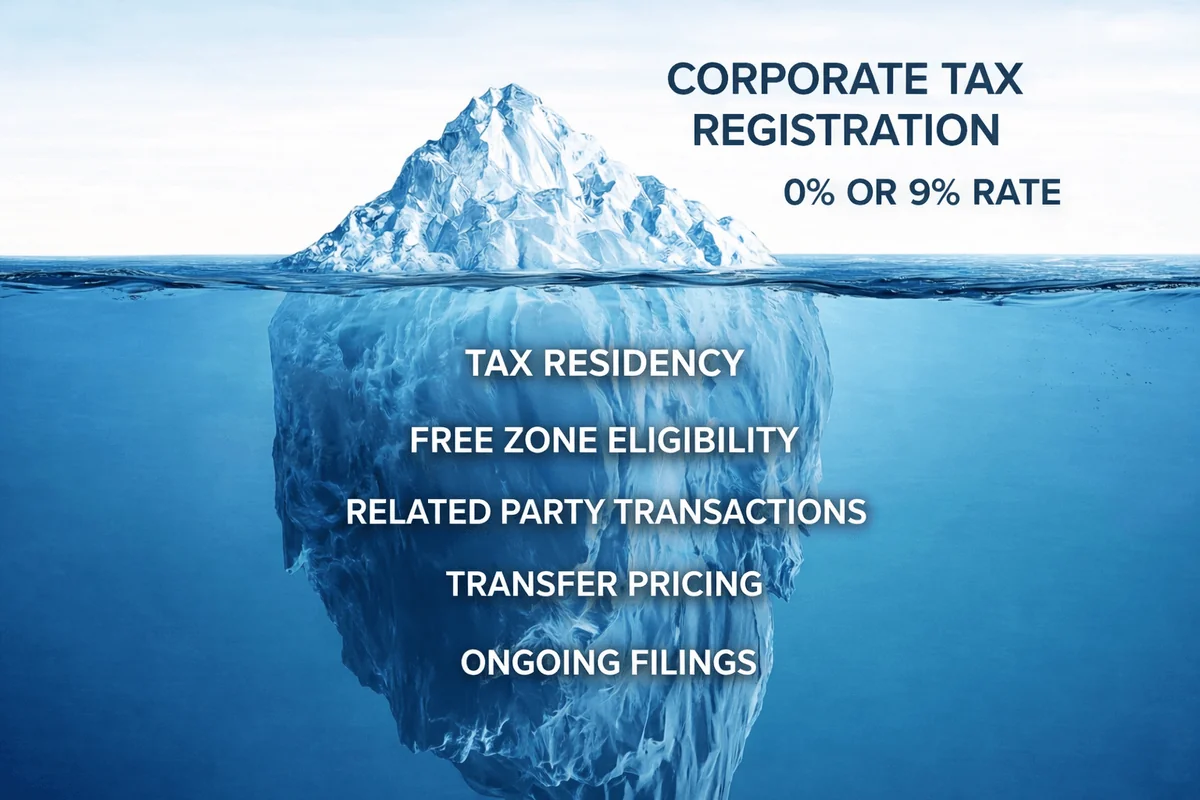
What Is Corporate Tax in UAE? 2026 Overview
What Is Corporate Tax in UAE? [2026 Overview]
For decades, the UAE was known as a tax-free haven for businesses. That changed in 2023 with the introduction of Federal Corporate Tax, fundamentally shifting how companies operate in the Emirates.
If you’re running a business in the UAE or planning to start one, understanding Corporate Tax isn’t optional anymore. It’s a legal requirement that affects your financials, compliance obligations, and long-term planning.
This guide explains what Corporate Tax is, who pays it, how much you’ll owe, and what it means for your business in 2026.
What Is Corporate Tax?
Corporate Tax is a direct tax on the net income (profits) of businesses and other juridical persons operating in the UAE. It was introduced through Federal Decree Law No. 47 of 2022 and became effective for financial years starting on or after June 1, 2023.
Unlike indirect taxes like VAT that are collected on transactions, Corporate Tax is calculated based on your annual profit after deducting eligible business expenses.
Why Did the UAE Introduce Corporate Tax?
The UAE introduced Corporate Tax for several strategic reasons.
First, to align with international tax standards and demonstrate compliance with the OECD’s Base Erosion and Profit Shifting (BEPS) framework. This positions the UAE as a transparent, globally compliant jurisdiction.
Second, to diversify government revenue streams and reduce reliance on oil-related income, supporting long-term economic sustainability.
Third, to maintain the UAE’s reputation as a serious, regulated business hub that meets global expectations for tax transparency while remaining competitive.
The tax was designed to be business-friendly, with low rates and generous exemptions for smaller businesses.
Who Needs to Pay Corporate Tax?
Corporate Tax applies broadly, but not universally. Here’s who’s required to register and potentially pay tax.
UAE Resident Businesses
All UAE companies and legal entities incorporated, established, or effectively managed in the UAE must register for Corporate Tax. This includes Limited Liability Companies (LLCs), Public Joint Stock Companies (PJSCs), Private Joint Stock Companies, and other corporate structures operating in the UAE.
Foreign companies that are effectively managed and controlled from the UAE are also considered UAE tax residents, even if they’re registered elsewhere. “Effectively managed” means the key business decisions, strategic direction, and day-to-day operations are conducted from the UAE.
Individual Business Owners
Natural persons (individuals) conducting business activities in the UAE are subject to Corporate Tax if their annual revenue exceeds AED 1 million. This excludes personal investment income, salary, or income from UAE real estate unless the real estate activity is conducted under a commercial license.
If you’re a sole proprietor or freelancer earning over AED 1 million annually from business activities, you’re required to register and file Corporate Tax returns.
Non-Resident Businesses
Foreign companies with a permanent establishment in the UAE must register and pay Corporate Tax on income attributable to that permanent establishment.
A permanent establishment generally means having a fixed place of business in the UAE, such as an office, branch, factory, or construction site lasting more than six months.
Free Zone Companies
Free Zone entities are subject to Corporate Tax just like mainland businesses. However, they may qualify for a 0% Corporate Tax rate on specific types of income if they meet strict eligibility conditions.
This is not automatic. Free Zone companies must demonstrate they qualify as a “Qualifying Free Zone Person” and earn “qualifying income” to benefit from the 0% rate. We’ll cover this in detail in a separate post.
Who Is Exempt from Corporate Tax?
While Corporate Tax applies broadly, certain entities are explicitly exempt under the law.
Exempt Entities
Government bodies and government-controlled entities performing sovereign or municipal functions. Businesses engaged in extractive industries, specifically the extraction of UAE natural resources such as oil and gas, which remain subject to Emirate-level taxation. Qualifying public benefit entities, including registered charities and non-profit organizations approved by the FTA. Qualifying investment funds that meet specific regulatory and structural criteria. Public and private pension or social security funds subject to regulatory oversight. Entities wholly owned and controlled by exempt persons. Non-commercial international and regional sports entities, as introduced by Cabinet Decision No. 1 of 2026.
Important Note on Exemptions
Even if your entity is exempt from paying Corporate Tax, you are still required to register with the Federal Tax Authority (FTA) and file annual declarations. Exemptions don’t eliminate your compliance obligations, they just mean you won’t owe tax.
Failing to register or file, even as an exempt entity, can result in penalties.
What Are the Corporate Tax Rates?
The UAE Corporate Tax structure is straightforward and designed to support small and medium-sized businesses.
Standard Tax Rates
0% tax on taxable income up to AED 375,000 per year. 9% tax on taxable income above AED 375,000 per year.
This is a tiered structure. The first AED 375,000 of your taxable income is taxed at 0%, and only the amount exceeding that threshold is taxed at 9%.
How the Calculation Works: An Example
Let’s say your business has a net profit (taxable income) of AED 600,000 in a financial year.
The first AED 375,000 is taxed at 0%, which equals AED 0. The remaining AED 225,000 is taxed at 9%, which equals AED 20,250. Your total Corporate Tax liability for the year is AED 20,250.
This structure ensures that smaller businesses with lower profits pay little to no tax, while larger, more profitable businesses contribute at a competitive 9% rate.
Special Rate: Large Multinationals
For large multinational groups with consolidated global revenues of at least EUR 750 million in at least two of the prior four years, the UAE has introduced a Domestic Minimum Top-Up Tax (DMTT) at 15%.
This aligns with the OECD’s global minimum tax framework (Pillar Two) and ensures that large international corporations operating in the UAE pay at least 15% tax on their UAE income.
Most small and medium-sized businesses will never encounter this. It’s designed specifically for very large multinational groups.
What Counts as Taxable Income?
Taxable income is not simply your revenue. It’s your net profit after deducting eligible business expenses, adjusted for certain tax rules.
Starting Point
Your taxable income calculation starts with your accounting profit, which should be prepared according to International Financial Reporting Standards (IFRS) or another accepted accounting framework.
From there, you make adjustments based on what the Corporate Tax Law allows as deductions and what it excludes or exempts.
Common Business Deductions
Employee salaries, wages, and benefits paid in the course of business. Rent, utilities, and office operating costs. Depreciation on business assets like equipment, vehicles, and property. Interest on business loans, subject to certain limitations. Professional fees for legal, accounting, consulting, and other business services. Cost of goods sold and inventory. Marketing and advertising expenses.
Common Exclusions and Adjustments
Dividends received from qualifying UAE companies are typically exempt from Corporate Tax. Capital gains on shares and securities may be exempt under specific conditions. Fines, penalties, and illegal payments are not deductible. Personal expenses are not deductible. Entertainment and hospitality expenses may have limitations.
The key is maintaining clear, organized financial records that separate deductible business expenses from non-deductible items. Poor record-keeping leads to errors, which can trigger audits or result in paying more tax than necessary.
Free Zone Corporate Tax: A Quick Overview
Free Zone companies are not automatically exempt from Corporate Tax, but they can benefit from a 0% rate on qualifying income if they meet specific conditions.
To qualify for the 0% rate, a Free Zone entity must be recognized as a Qualifying Free Zone Person (QFZP) by meeting substance requirements, earning qualifying income (generally income from transactions with non-UAE mainland entities), and maintaining full compliance with Free Zone and FTA regulations.
Even if you qualify as a QFZP, income from UAE mainland customers is considered non-qualifying income and is taxed at the standard 9% rate.
We’ll cover Free Zone Corporate Tax in detail in a dedicated blog post, including how to determine if you qualify and how to calculate tax on mixed income streams.
When Does Corporate Tax Apply?
Corporate Tax became effective for financial years starting on or after June 1, 2023.
If your financial year begins on January 1, your first Corporate Tax period started on January 1, 2024. If your financial year begins on July 1, your first Corporate Tax period started on July 1, 2023.
This means most UAE businesses have already entered the Corporate Tax regime and need to be actively managing their compliance.
What Are Your Key Obligations?
Once Corporate Tax applies to your business, you have three core obligations.
Registration
You must register for Corporate Tax with the FTA within specific deadlines. For new businesses established after June 1, 2023, registration must be completed within 3 months of company registration. Missing this deadline results in an automatic penalty of AED 10,000.
Filing
You must file an annual Corporate Tax return within 9 months after the end of your financial year, regardless of whether you owe any tax. Even if your taxable income is zero or you qualify for an exemption, you still need to file.
Payment
If you owe Corporate Tax, payment must be made within 9 months of your financial year end, at the same time as filing your return. Late payment attracts interest at 14% per annum.
We’ll cover registration, filing, and payment processes in detail in upcoming blog posts.
What Happens If You Don’t Comply?
Corporate Tax penalties are structured and automatic. The FTA’s systems are digital and enforce deadlines strictly.
Late registration carries a flat penalty of AED 10,000. Late filing attracts AED 500 per month for the first 12 months, increasing to AED 1,000 per month from the 13th month onward. Late payment of tax owed results in interest charges of 14% per annum, calculated monthly. Incorrect or fraudulent returns can result in additional penalties ranging from AED 500 to much higher amounts depending on the severity.
The penalties are not negotiable, and they accumulate until the issue is resolved. The best approach is to stay ahead of deadlines and maintain compliance from the start.
How Corporate Tax Fits into the UAE Tax System
Corporate Tax is now part of a broader UAE tax framework that includes VAT at 5% on most goods and services, Excise Tax on specific products like tobacco, sugary drinks, and energy drinks, and Emirate-level taxation on certain extractive industries like oil and gas.
These taxes operate independently. A business may be subject to Corporate Tax on its profits, VAT on its transactions, and potentially Excise Tax if it deals in regulated products. Each has its own registration, filing, and compliance requirements.
What This Means for Your Business
Corporate Tax is now a permanent part of doing business in the UAE. It’s not going away, and compliance requirements will only become more sophisticated as the system matures.
The businesses that handle this well are not the ones trying to avoid or delay compliance. They’re the ones who treat Corporate Tax as a normal part of operations, maintain clean financial records throughout the year, understand their obligations and meet deadlines consistently, and work with professionals who bring clarity and structure to the process.
You don’t need to become a tax expert. You just need to know where you stand, understand your obligations, and have systems in place to meet them without stress.
Next in this series: Learn exactly how to register for Corporate Tax, what documents you need, and how to avoid the AED 10,000 late registration penalty.
Need help with Corporate Tax compliance? At Lumea Finance, we help UAE businesses navigate Corporate Tax with clarity and confidence. Whether you need to register, understand your tax position, or ensure you’re fully compliant, we take ownership from start to finish. Let’s talk here about bringing structure to your tax obligations.
